
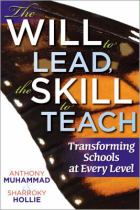
Book cover for The Will to Lead  the Skill to Teach : Transforming Schools at Every Level
Description
Authors Anthony Muhammad and Sharroky Hollie acknowledge both the cultural and structural issues that contribute to low-performing schools and encourage educators to reflect on their attitudes and practices to self-evaluate their approach to school improvement. Chapters 2 through 5 focus on the development of a staff¿s will¿that is, their belief in all students¿ abilities and their determination to make student learning and success the priority in their schools. Educators must be leaders of this will within their school culture, both for students and for their colleagues and members of the community. They must strive to create a healthy school culture for the ultimate benefit of students. Chapters 6 through 11 are dedicated to the examination and discussion of a staff¿s skill¿their use of quality methods and strategies within their instruction to ensure student success. These quality methods and strategies combine to form what the authors call a responsive pedagogy, which uses selected instructional practices as a bridge from students¿ home, cultural, and linguistic experiences to the academic world. Whereas a traditional pedagogy is typically a one-way interaction and teacher directed, responsive pedagogy is steeped in two-way interactions that tend to be student directed. The authors assert that will and skill must go hand in hand, and that current arguments in the field of education have not addressed these issues together; rather, they have been treated as isolated issues. The will section of the book presents four broad steps to developing a positive learning environment: (1) aligning philosophy, (2) managing frustration, (3) creating a culture of collaboration, and (4) institutionalizing a healthy culture. The skill section of the book defines and develops the components of a responsive pedagogy¿a skillful and balanced framework of traditional and culturally responsive activities used within the classroom¿focusing on four areas of instruction that practicing teachers must master in order to increase the level of success for all students: (1) responsive classroom management, (2) responsive academic vocabulary, (3) responsive academic literacy, and (4) responsive learning environment. The authors assert that educators must take the myriad of recommendations and prescriptions for effective teaching and use them responsively to benefit students. Although the authors note that a responsive pedagogy is beneficial to all students, they argue that it is most beneficial to underserved students¿any student who is not successful academically, socially, and/or behaviorally in school because the institution is not being responsive to their needs. These students are often students of different races, cultures, and languages; special needs students; or students from low socioeconomic backgrounds. A responsive pedagogy developed within a healthy school culture where educators have the will to lead students to success includes validating and affirming activities, policies, and procedures. The introduction and chapter 1 introduce the concepts of will and skill and describe the four zones of a positive learning environment. Chapter 2 presents the importance of a healthy school culture and outlines its three major components. It examines the development of a collective commitment to success for all students. Chapter 3 examines the factors that contribute to teacher frustration and create a toxic culture. Chapter 4 describes two cultural subsets that create school culture, collegial culture and managerial culture, and explains the importance of communicating expectations in creating a healthy school culture. Chapter 5 discusses the roles and responsibilities of each party involved in developing a healthy school culture: teachers, professional staff, site and central administrators, and policymakers at the state and federal level. Chapter 6 introduces the concept of responsive pedagogy. Chapter 7 describes a three-step process for making instruction responsive and discusses the four recommended instructional areas for implementation. Chapter 8 explores specific activities to infuse responsive pedagogy into classroom-management systems, including techniques for responding and discussion and the effective use of attention signals and movement activities to increase student engagement and decrease classroom-management issues. Chapter 9 explores specific activities and tools, such as the personal dictionary and personal thesaurus, to create responsive instruction in academic vocabulary. Chapter 10 focuses on the development of responsive instruction in academic literacy and includes a number of effective, research-based literacy strategies for educators to use in their own practice, such as engaging students with culturally and linguistically responsive texts. Chapter 11 describes the benefits and essential ingredients for creating a responsive learning environment. Throughout the skill section, the authors draw on specific successful strategies used at Dr. Hollie¿s laboratory school, the Culture and Language Academy of Success. Throughout this book, the authors challenge educators to look at themselves as not just a part of the problem, but part of the solution. They emphasize that school improvement begins with self-examination and honest dialogue around topics that are often avoided and suppressed, like socialization, bias, discrimination, and cultural insensitivity. The authors encourage educators to look at their current practices with an honest, critical eye, which will enable them to identify their areas of need. This resource provides them with the tools they will need to improve in those areas.
Publisher Solution Tree Press
ISBN10 1935542540
ISBN13 9781935542544
Number of Pages 176
File Size DL-79MB
Shelf Number KX481
Grade Range
Ages 18 - 99
Format Audio Plus Download, EPub Download